Temperature Definitions and Terms of Industrial SSD - Part I
Temperature Definitions and Terms of Industrial SSD - Part I
Higher temperatures speed up physical and chemical processes. This is especially true in regards to the damage of NAND flash memory cells. This means that the endurance of a NAND flash can be reduced significantly if it is used at higher temperatures. This effect is greater in higher density flashes that store multiple threshold levels as they are more sensitive to changes in the properties of the insulating layer.
To maximize the useful lifetime of a NAND flash, the flash memory controller needs to monitor and adapt to these changes. Temperature cycling due to changes in ambient temperature and devices being powered on and off also cause physical stress in components because different materials expand and contract at different rates. This can eventually cause electrical connections to break.
Figure 1 Model of Device Thermal Resistance Parameters Figure
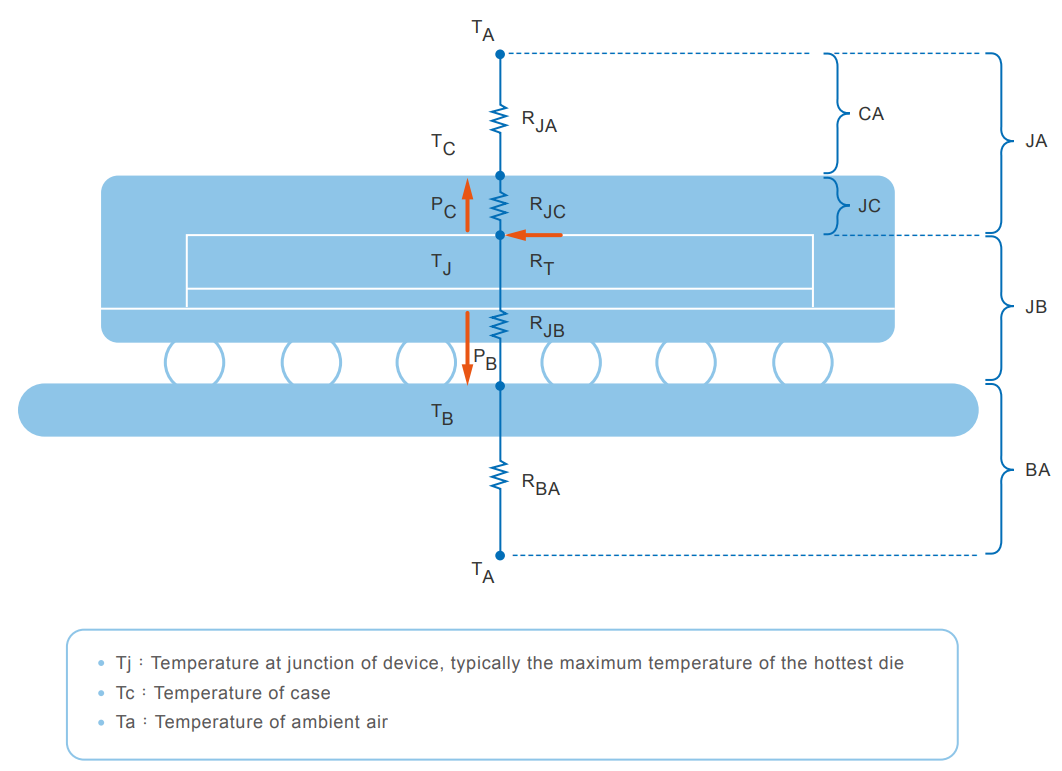
Junction Temperature (Tj)
The die temperature, TJ, is probably the most difficult to measure, but is the most important to understand or be able to estimate to ensure functionality and reliability of the product. SSD controller has an internal temperature sensor
that enables a measurement within the die at a specific location.
Case Temperature (Tc)
The case temperature should be measured by attaching a thermocouple to the top center of the component.
This should be done with a 1mm bead of conductive epoxy, as defined by the JEDEC EIA/JESD51 standards. Care should be taken to ensure the thermocouple bead is touching the case.
Ambient Temperature (Ta)
Ambient temperature is defined as the system ambient temperature, the temperature of the incoming or outgoing air temperature. It is defined as the operating temperature of Silicon Power Industrial SSD products.
Temperature monitoring
Off-the-shelf software utilities such as Crystal Disk Information (CDI) or PassMark BurnInTest shows temperature measured by SMART information. The default SMART shows the temperature information Junction temperature (Tj) of
the SSD controller. Tj is the real die temperature of the SSD controller measured by SMART of SSD FW. Such temperature is different from ambient temperature (Ta). If using Infrared thermal image sensor to scan the surface
temperature of SSD controller, it shows the case temperature (Tc) of SSD controller. Usually Tj is higher than Tc and
Tc is higher than Ta.
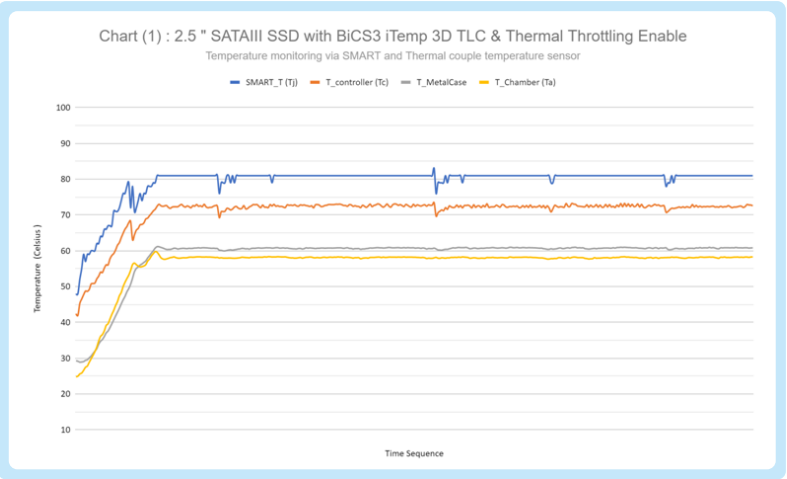
Chart (1) shows the temperature monitoring of 2.5” SATA SSD which is tested on ambient temperature Ta from room temperature to 60 degrees celsius. Thermal throttling mechanism refers to Tj to adjust performance of SSD controller and keep Tj around the highest temperature 80 degrees celsius.
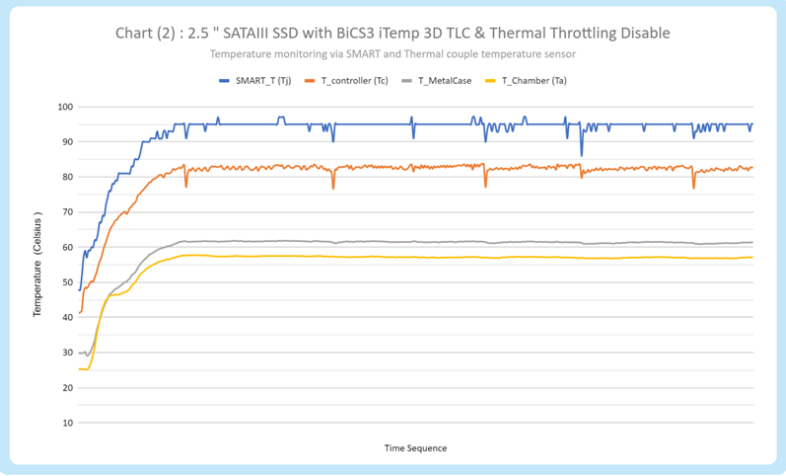
Chart (2) shows the temperature monitoring of 2.5” SATA SSD with disable thermal throttling mechanism which is tested on ambient temperature Ta from room temperature to 60 degrees celsius. Without Thermal throttling mechanism to adjust the performance of SSD controller Tj will goes as high as 95 degrees celsius when Ta is 60 degrees celsius.
The specification of the Tj of the SSD controller can support up to 125 degrees celsius. Both testing conditions still are managed under the specification of SSD controller.