


__26A14m2ydK.jpg)
Enterprise SSDs: Applications, Requirements & Key Specifications
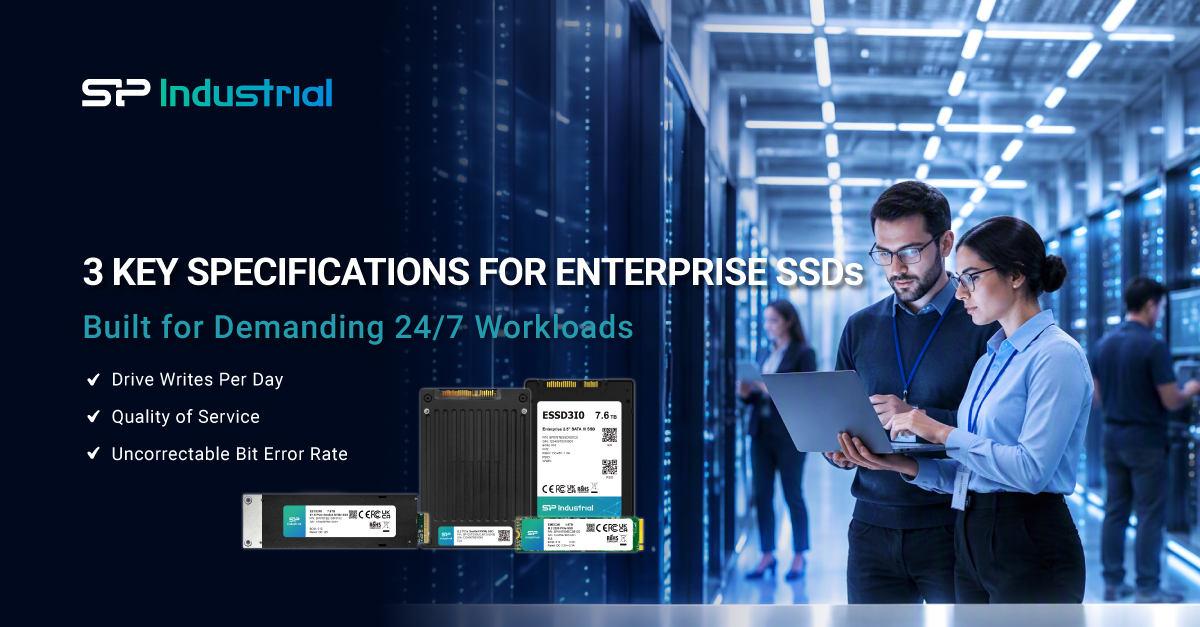
Modern computing infrastructure relies on high-performance storage to process and manage growing volumes of data. From data centers and enterprise servers to cloud computing and AI infrastructure, SSDs play an important role in supporting demanding workloads. However, enterprise storage requires more than high speed and capacity. High endurance, consistent performance, and data integrity are essential for systems designed to operate continuously.
Understanding key enterprise SSD specifications helps organizations evaluate storage solutions based on their workload requirements and operational demands.
Enterprise SSDs for Demanding Applications
Enterprise SSDs are used across a wide range of computing environments where reliable storage performance is essential.
In data centers, SSDs handle large volumes of data and continuous read/write operations. Enterprise servers rely on storage performance to support databases, virtualization, and business-critical applications. In cloud computing, SSDs help service providers manage multiple workloads while maintaining predictable response times. Meanwhile, AI infrastructure depends on efficient storage access to support data processing, model training, and inference workloads.
Across these applications, enterprise SSDs must support intensive operations while maintaining stable performance and reliable data storage.
Key Requirements for Enterprise SSDs
Enterprise SSDs are designed for 24/7 operation and demanding workloads. High endurance enables drives to withstand sustained write activity over their rated service life, while consistent performance helps minimize latency fluctuations under heavy workloads. Data integrity is equally important, particularly in environments that process and store large amounts of critical information.
Several specifications help evaluate these characteristics, including Drive Writes Per Day (DWPD), Quality of Service (QoS), and Uncorrectable Bit Error Rate (UBER).
Understanding Three Key Enterprise SSD Specifications
DWPD (Drive Writes Per Day)
DWPD indicates how many times an SSD's full storage capacity can be written per day over its rated endurance period. This specification helps determine whether a drive can withstand the write intensity of its intended workload. For data centers and servers that continuously process and update data, an appropriate DWPD rating is an important consideration for long-term operation.
SP Industrial Enterprise SSDs offer endurance ratings of up to 3 DWPD, supporting demanding enterprise workloads.
QoS (Quality of Service)
In enterprise storage, QoS describes performance consistency, particularly I/O latency under specified workloads. While peak performance indicates how fast a drive can operate under certain conditions, QoS focuses on how predictably it responds as workloads and demand change.
Consistent QoS helps reduce unexpected latency spikes and maintain predictable response times in multi-user environments. SP Industrial prioritizes QoS in its Enterprise SSD design, aiming to deliver stable performance and predictable latency for demanding applications.
UBER (Uncorrectable Bit Error Rate)
UBER measures the rate of data bit errors that remain uncorrected during read operations. A lower UBER indicates a lower rate of uncorrectable errors, making it an important specification for assessing storage reliability and data integrity.
For enterprise environments handling large-scale data processing and storage, minimizing uncorrectable errors helps support reliable operations. SP Industrial Enterprise SSDs specify a UBER of 10⁻¹⁷.
Enterprise Storage with SP Industrial
Selecting an enterprise SSD requires evaluating more than capacity and transfer speeds. DWPD provides insight into write endurance, QoS addresses performance consistency, and UBER helps assess data integrity. Together, these specifications offer a clearer understanding of how a drive can meet the demands of enterprise workloads.
SP Industrial Enterprise SSDs are designed to support demanding storage environments, including data centers, servers, cloud computing, and AI infrastructure.
Explore the complete Enterprise SSD series here: Enterprise SSDs-Solutions-SP Industrial.